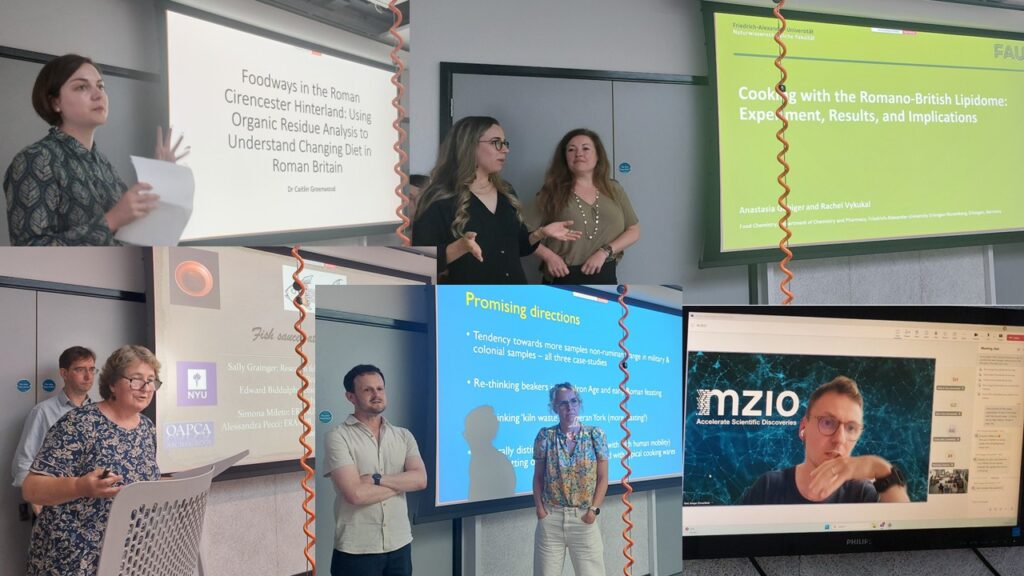
This month the Roman melting pots project team convened a 2-day workshop at the University of Exeter to share emerging results with partner organisations and specialists in the fields of organic residue analysis (ORA), Roman pottery studies, and ancient foodways. The second day of the meeting provided an opportunity to contextualise the project’s findings with parallel research into ORA on pottery elsewhere in the Roman world. All in all, the meeting provided an exciting glimpse into state-of-the-art application of ORA in Roman archaeology, featuring wide-ranging discussions into both new findings and promising future directions.
Martin Pitts kicked off the workshop with an overview of the aims of the Roman melting pots project, identifying the rationale and likely pay-offs for applying ORA to the archaeologically-rich case-studies of first century post-conquest Colchester, early second century Vindolanda, and Severan York. Attention was given to the criteria for selecting 1000+ pottery sherds from archaeological collections, of which 700+ have been sampled using organic residue analysis methods on the project. Before getting to the results of these analyses, Caitlin Greenwood presented a summary of her PhD research and 2023 Britannia article (https://doi.org/10.1017/S0068113X23000181 ) on the findings of ORA on pottery from the Roman Cirencester hinterland. Caitlin’s presentation provided valuable background on what might be expected from lipid residues from pottery in the late Iron Age to Roman transition, as well as urban-rural relations from the first to fourth centuries CE. Rachel Vykukal and Anastasia Gabiger then spoke about the fascinating outcomes of cooking experiments undertaken with replica Roman pots, which have massive implications for not only the differential absorption of lipids from different foodstuffs in ceramics, but also the tendency of some foodstuffs and even some lipids to be better absorbed in some parts of pots than others (i.e. distinctions between the ‘water line’ and bases of vessels).
These findings were contrasted with the initial ORA results from archaeological samples from the Roman melting pots project, presented by Lucy Cramp and Miya Zhang. A spectrum of similarities and differences emerged between the case-studies of Cirencester, Colchester, Vindolanda and York, with a recurrent threads of discussion including the distinction (or lack thereof) between the evidence for specialist consumption of dairy and non-ruminant products in different sites and historical periods, and the multi-functionality of different kinds of ceramic vessels. A big takeaway from this presentation was the sheer richness of the data collected on the Roman melting pots project, and the necessity of a big data mining approach to really do justice to the data gathered in forthcoming stages of analysis. This important thread of thought was picked up and elaborated in the presentations by Simon Hammann and Ansgar Korf, who respectively sketched the full implications of a) why big data analysis of ORA data is needed and what it should do, and b) the practicalities of realising these aims using bespoke data-mining software with the data collected in this project.
All in all, lots of exciting preliminary ORA results were shared on day 1 of the workshop, with Martin Pitts highlighting a number of areas in which research seemed to have been especially promising. Provisional strands emerging from the analyses included a) the possibility of some culturally diverse environments being distinguished by a higher proportion of pottery residues outside typical/expected isotopic ranges for given regions/periods; b) ORA data contradicting prevailing assumptions about the way both selected sites and pottery vessels had been used in the Roman period; and c) a tendency for Roman pottery vessels associated with human mobility to plot outside the spectral range of more typical cooking wares. These suggestions will be explored as the results of the project are further investigated and enhanced by further analysis and research.